

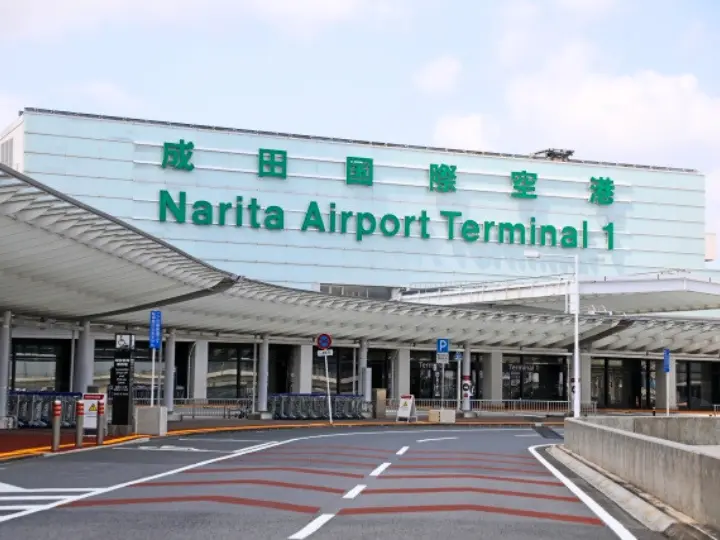
Tokyo Airport Transportation Guide | Fastest Routes from Narita & Haneda to Shinjuku, Ueno & Asakusa
A complete guide to transportation from Tokyo’s Narita and Haneda airports! Compare options such as the Keisei Skyliner and Narita Express (N’EX) to quickly find the most suitable travel method for your journey.
When planning a Tokyo trip, the first challenge is often airport transportation. Tokyo has two major airports: Narita International Airport (NRT) and Haneda Airport (HND), each located at very different distances from the city center.
This guide provides a detailed breakdown of the best transportation options from both airports to central Tokyo, and compares services such as the Keisei Skyliner and limousine buses. Even first-time travelers can easily choose the most suitable way to reach the city.
Narita vs Haneda: Tokyo Airport Location and Transportation Guide
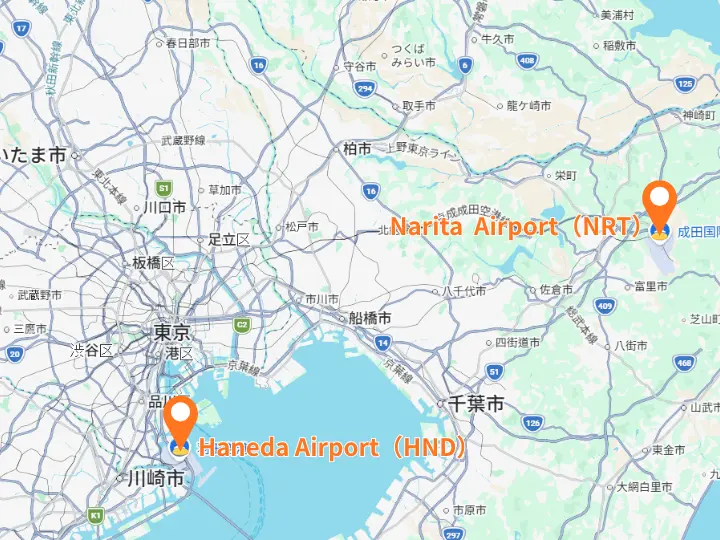
Before exploring the various transportation options for visiting Tokyo, it is important to first understand the locations and key features of the airports. The table below provides detailed information on Narita and Haneda Airports, including their route characteristics and distance from central Tokyo.
Introduction to the Differences Between Narita and Haneda Airports
| Comparison Factors | Narita Airports(NRT) | Haneda Airports(HND) |
| Location & Features | Located in Chiba Prefecture, Narita Airport is farther from central Tokyo. It serves a large number of international routes and is a major hub for both full-service carriers and low-cost airlines. | Located within Tokyo, very close to the city center. It can significantly reduce travel time. |
| Travel Time to City Center | Approximately 40–90 minutes. The fastest option takes only about 36–41 minutes to reach Nippori or Ueno via the Skyliner. | Approximately 15–30 minutes, with the fastest option taking only about 11–13 minutes to reach Shinagawa via the Keikyu Line. |
| Direct Flights from Taiwan | Taoyuan(TPE)/Taichung(RMQ)/Kaohsiung(KHH) | Taipei Songshan(TSA)/Taoyuan(TPE) |
| Recommended Transportation Options | Skyliner, N’EX (Narita Express), Keisei Main Line Limited Express, Access Express, Airport Limousine Bus、LCB (low-cost bus) | Keikyu Railway, Tokyo Monorail, Airport Limousine Bus |
Narita Airport Transportation Guide: A Comparison of 4 Main Options
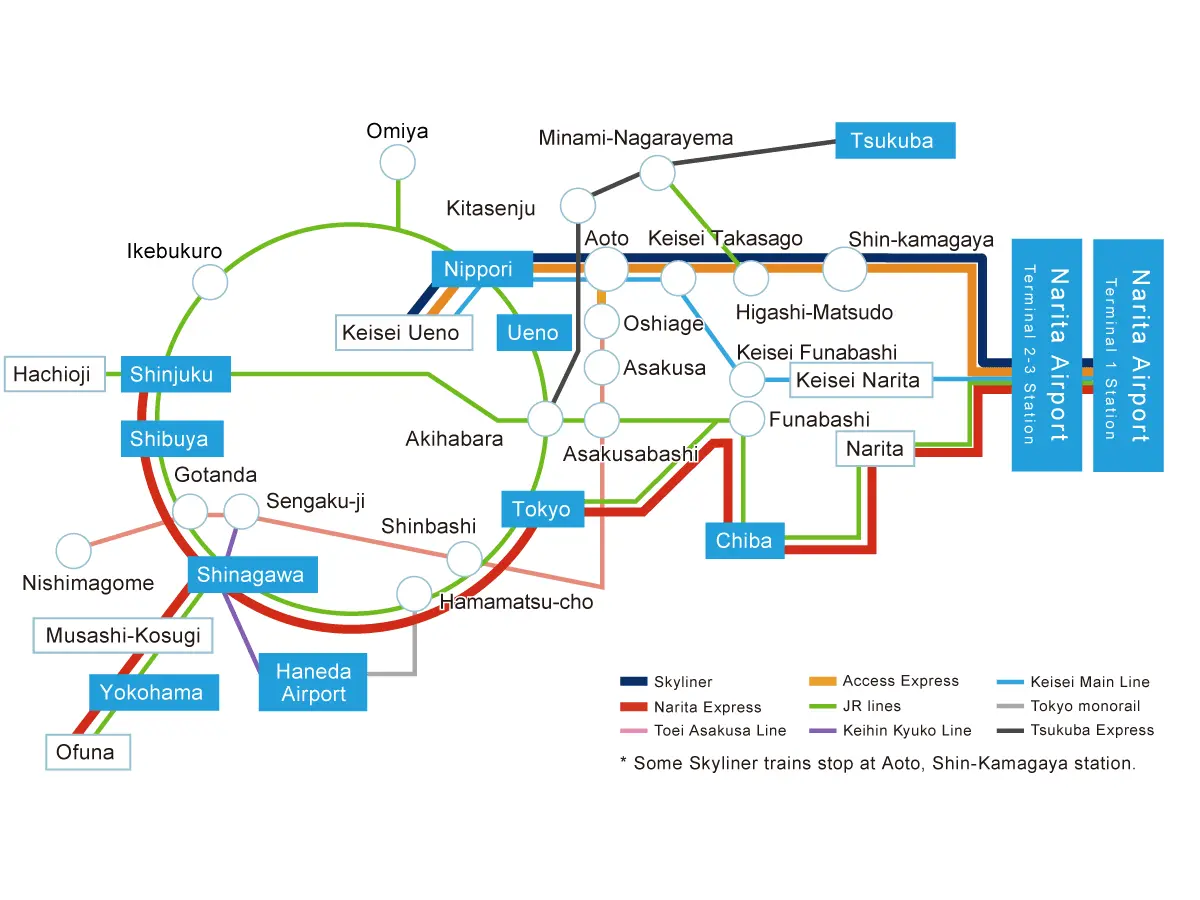
Image Source:©NARITA INTERNATIONAL AIRPORT CORPORATION
There are many transportation options from Narita Airport to central Tokyo, which can be confusing for first-time visitors. In addition to the options introduced above, the table below provides a detailed comparison of the four main transportation methods and their key features:
| Operator | Transportation Options | Features&Suitable For |
| Keisei Electric Railway Co., Ltd. | Skyliner
(All seats are reserved) |
Fast service with fully reserved seating. Discounted tickets are available for foreign travelers. Best suited for those prioritizing speed and comfort, especially travelers heading to Ueno. |
| Access Express | Direct service with no transfers required to Asakusa, Nihombashi, and Ginza. Ideal for travelers staying along the Toei Asakusa Line. | |
| Keisei Main Line Limited Express, | The cheapest option with frequent departures, but a longer travel time. There are no dedicated luggage racks, making it best suited for budget travelers who are not in a hurry. | |
| East Japan Railway Company | N’EX
(All seats are reserved) |
Direct access to major stations such as Shinjuku and Shibuya. Discounted fares are available for foreign travelers, and it is especially suitable for JR Pass holders. |
| Airport Transport Service Co., Ltd. | Airport Limousine Bus | Direct service to hotel entrances with no need to carry luggage, making it ideal for families or travelers with heavy baggage. |
| Operated by multiple companies | LCB (low-cost bus) | Direct services to Tokyo, Ginza, Ikebukuro, and other major stations with frequent departures and affordable fares. Ideal for budget-conscious travelers with light luggage. |
✨Narita Airport Rail Guide: Master the Gates and Never Get Lost
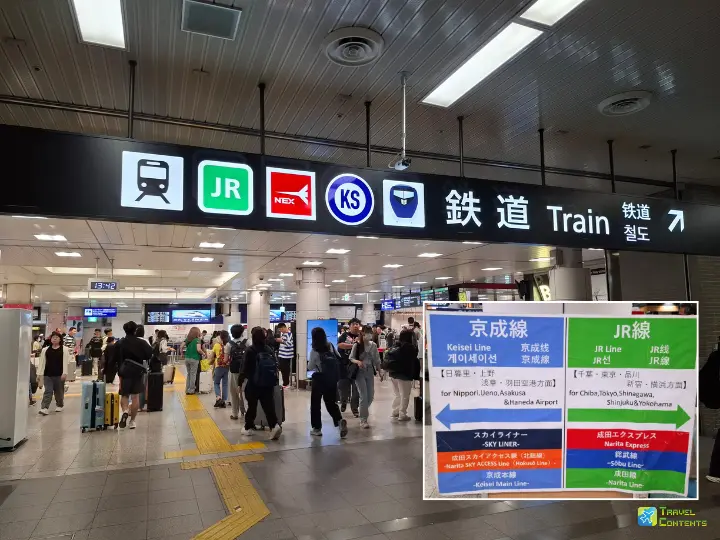
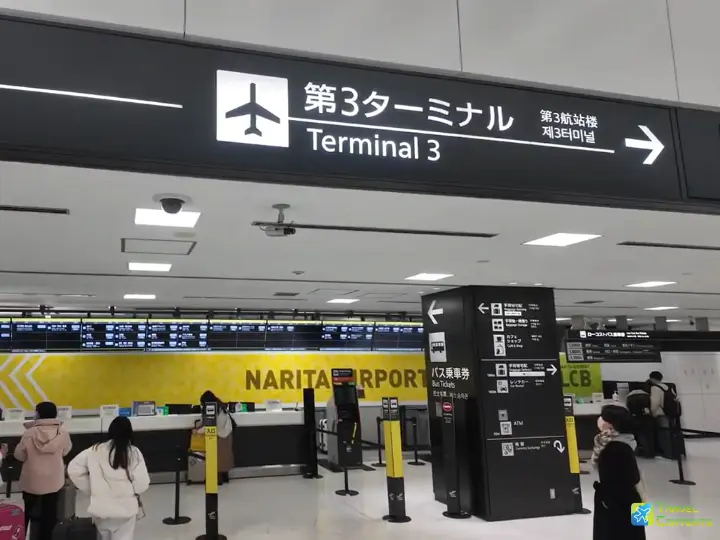
After disembarking and clearing immigration, please follow the signs to the B1 railway area. When you see the hall shown in the image, you’ll know you’re almost at your destination! This area brings together the ticket gates of various railway operators. To avoid going the wrong way, the quickest way to identify your route is by checking the operating company.
Upon reaching the gate, please check the direction carefully. For Skyliner, Access Express, and Keisei Main Line operated by Keisei Electric Railway, please use the left gates. For the Narita Express operated by JR East, please use the right gates. By identifying the two main operators, you can enter the station quickly and continue your journey into the city with ease.
N’EX (Narita Express) | Free for JR Pass holders
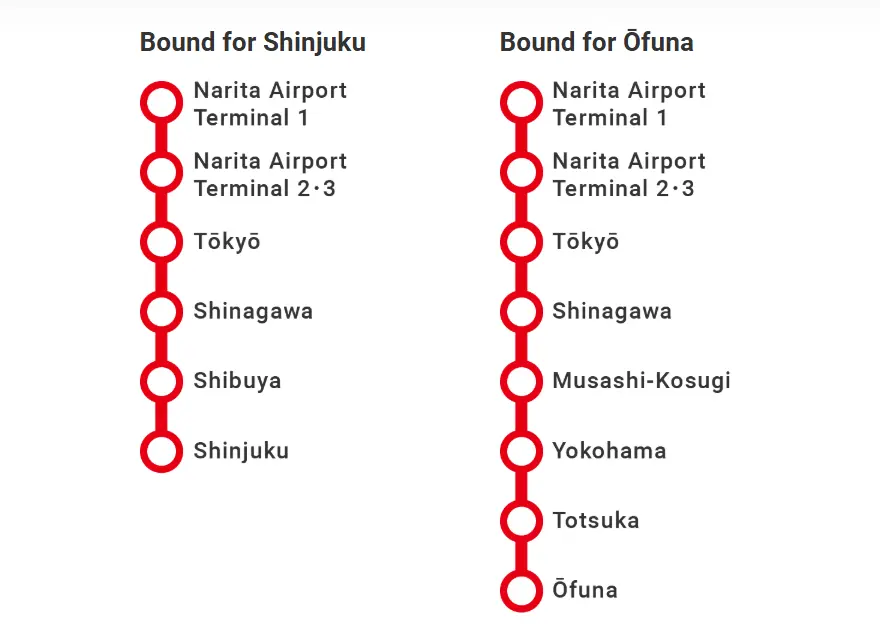
N’EX (Narita Express) is a limited express train operated by JR East. All seats are reserved, and its routes mainly cover the western part of central Tokyo and the Kanagawa area. From the airport, it takes as little as about one hour to reach Tokyo Station directly, with further connections to major hubs such as Shinjuku and Shibuya.
For foreign travelers, there is a special discounted “N’EX Tokyo Round Trip Ticket,” which allows one round trip within 14 days. In addition, holders of JR passes such as the JR TOKYO Wide Pass can ride the N’EX for free during the validity period.
- Fare Reference: Tokyo – JPY 3,140 / Shinjuku – JPY 3,330 / Tokyo Round Trip Ticket – JPY 5,200
Skyliner | Reach Ueno in Just 40 Minutes
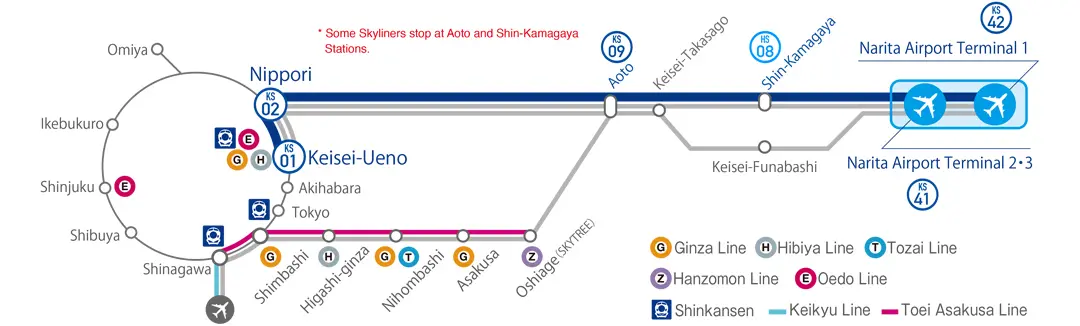
Image Source:Copyright © Keisei Electric Railway Co., Ltd. All Rights Reserved.
The Skyliner is Keisei Electric Railway’s flagship airport service, known for its all-reserved seating and high-speed travel. Departing from Narita Airport, it stops at Nippori and Keisei Ueno Stations, reaching Ueno in as little as 40 minutes.
For travelers staying in areas such as Ueno, Nippori, or Asakusa, the Skyliner is one of the most convenient and time-efficient ways to travel from the airport to the city. With reliable schedules and comfortable seating, it is especially suitable for first-time visitors to Tokyo or those traveling with luggage, helping to minimize transfer hassles and get your trip off to a smooth start.
- Fare Reference: Nippori / Keisei Ueno – JPY 2,580
Access Express|Direct Service to Asakusa and Ginza with No Transfers Required
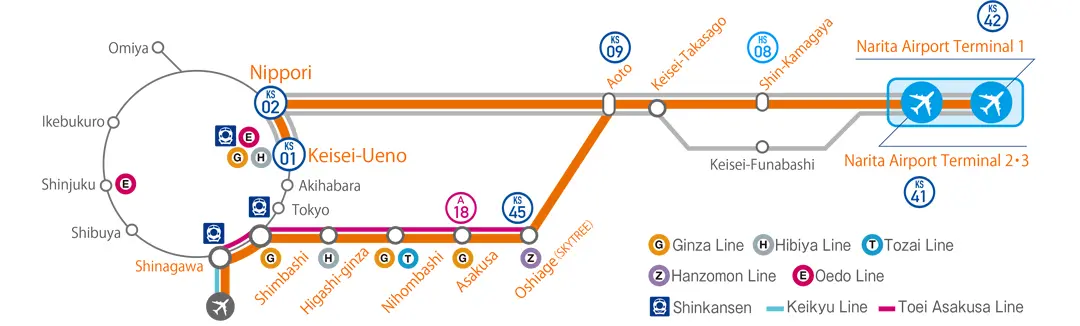
Image Source:Copyright © Keisei Electric Railway Co., Ltd. All Rights Reserved.
The biggest advantage of the Access Express is its convenient through-service operation. In addition to services terminating at Keisei Ueno Station, most trains run directly onto subway lines, allowing passengers to reach Asakusa, Nihombashi, and Shimbashi without transferring.
No additional limited express ticket is required—simply tap an IC card such as Suica or PASMO to enter and exit smoothly.
- Fare Reference: Keisei Ueno – JPY 1,280 / Asakusa – JPY 1,380 / Shimbashi – JPY 1,420
Keisei Main Line Limited Express | Best Budget-Friendly Option
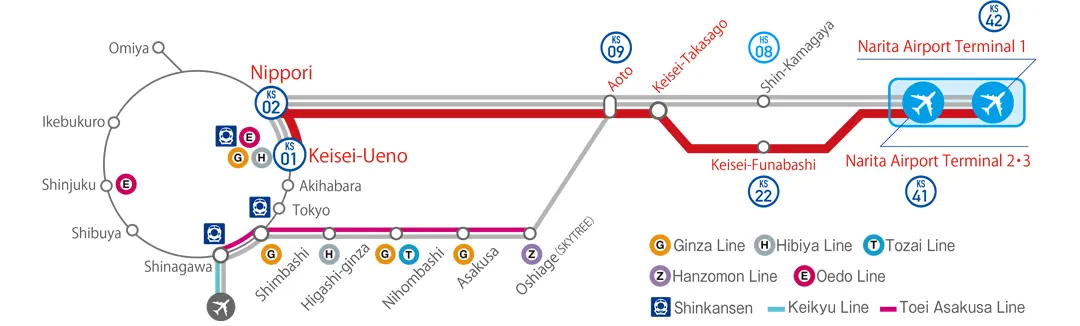
Image Source:Copyright © Keisei Electric Railway Co., Ltd. All Rights Reserved.
The Keisei Main Line operates on the existing conventional route, with frequent departures and low fares as its main advantages. Although it makes many stops along the way and features commuter-style long bench seating without dedicated luggage racks, it offers excellent value for budget-conscious travelers. No seat reservation is required—simply tap an IC card to enter the station and board quickly.
- Fare Reference: Keisei Ueno – JPY 1,060 / Asakusa – JPY 1,180
Haneda Airport Transportation Guide: Two Fast Ways to Reach Central Tokyo
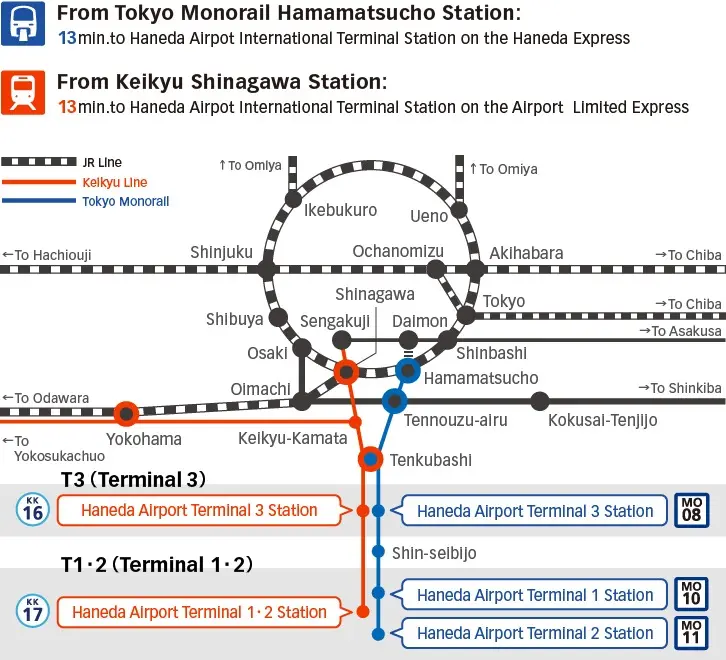
Image Source:© 2007 Japan Airport Terminal Co.,Ltd.
There are three main transportation options from Haneda Airport to central Tokyo. In addition to the Limousine Bus, travelers who prioritize speed can choose either the red line “Keikyu Railway” or the blue line “Tokyo Monorail” shown above. If you are unsure which to take, the detailed explanations and features below will help you choose the most suitable option based on your needs.
Haneda Airport to Tokyo City Center Transportation Comparison Table
| Transportation Options | Features&Suitable For |
| Keikyu Railway | The most cost-effective option, with direct access to Asakusa or transfer at Shinagawa to the Yamanote Line. It is ideal for budget travelers and those staying in areas such as Shinagawa, Asakusa, Oshiage, Shimbashi, and Nihombashi. |
| Tokyo Monorail | Frequent departures with easy transfers to the Yamanote Line. Free for JR Pass holders. It is ideal for travelers staying around Hamamatsucho, Shimbashi, Tokyo Station, Akihabara, or Ueno. |
| Airport Limousine Bus | Direct service to hotel entrances without the need to carry luggage, making it ideal for families or travelers with heavy baggage. |
Keikyu Railway | Direct Service to Shinagawa & Asakusa
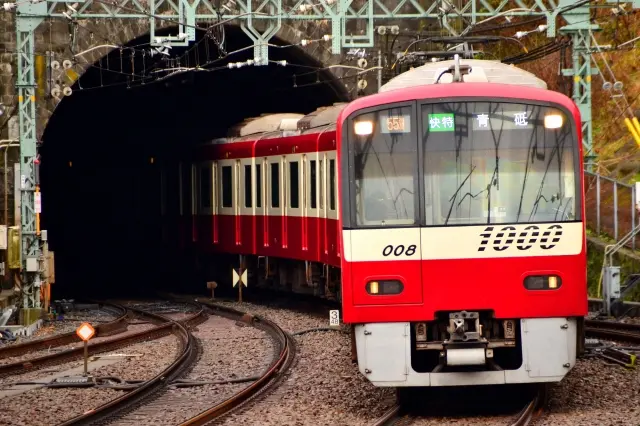
Image Source:Copyright © Keisei Electric Railway Co., Ltd. All Rights Reserved.
From Haneda Airport, Keikyu Railway not only provides access to Yokohama but also serves as a key route to Shinagawa and Asakusa. Trains bound for Shinagawa are divided into services terminating at Shinagawa Station and through-service trains that connect directly to the Toei Asakusa Line. With these trains, passengers can reach popular areas such as Asakusa and Oshiage (Tokyo Skytree) without transferring.
- Fare Reference: Shinagawa – JPY 330 / Asakusa – JPY 650
Tokyo Monorail | Direct to Hamamatsucho with JR Yamanote Line Connection
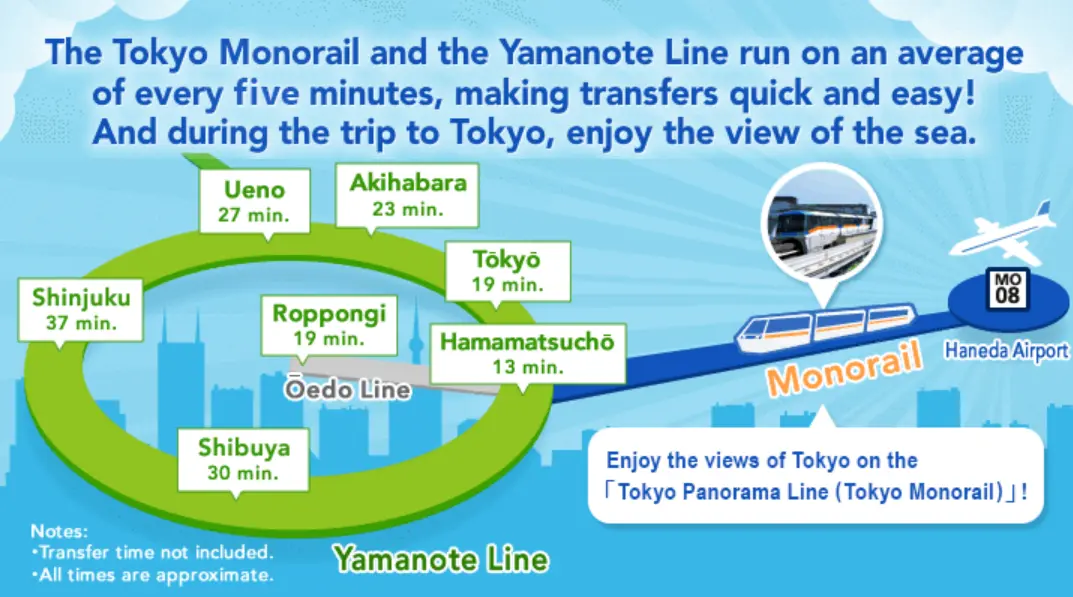
Image Source:Copyright © Tokyo Monorail Co.,Ltd. All Rights Reserved.
The Tokyo Monorail operates with frequent departures and can reach Hamamatsucho Station in as little as 13 minutes from Haneda Airport. From there, passengers can transfer to the JR Yamanote Line, connecting to major areas such as Tokyo Station, Ueno, and Shinjuku. Holders of JR passes such as the JR Tokyo Wide Pass can also ride the monorail free of charge during the validity period.
- Fare Reference: Hamamatsucho – JPY 520
How to Get to Shinjuku, Ueno, Asakusa & Ikebukuro from Tokyo Airports | Recommended Routes
Transportation from Tokyo airports may seem complicated due to the many options, but you don’t need to memorize every route. By first identifying where you are staying, you can quickly narrow down your choices.
For example, if you are staying around Ueno or Nippori, the Skyliner is usually the most convenient option. If your accommodation is in the Shinjuku or Tokyo Station area, the N’EX (Narita Express) is often the most straightforward choice.
For arrivals at Haneda Airport, you can choose between Keikyu Railway, Tokyo Monorail, or the Limousine Bus, depending on your hotel location and the amount of luggage you are carrying.
Staying in Shinjuku | Recommended: N’EX or Limousine Bus
Shinjuku is one of the most popular areas to stay in Tokyo, with plenty of department stores, restaurants, and transport options nearby. However, as Shinjuku Station is extremely large, first-time visitors to Tokyo may find it a bit confusing when transferring between lines.
If departing from Narita Airport, it is recommended to prioritize the JR N’EX (Narita Express), which provides direct access to Shinjuku Station. It is ideal for travelers who want to minimize transfers and head straight into the city center.
If you are traveling with heavy luggage, elderly family members, or children, the Airport Limousine Bus is also a good option. Although travel time may be affected by traffic conditions, it offers direct access to certain hotel entrances, eliminating the need to carry luggage through stations, platforms, or stairs.
Staying in Ueno | Skyliner for Fast Direct Access
If your accommodation is located in Ueno or Nippori, the Skyliner is a highly recommended airport transportation option from Narita Airport. The Skyliner takes as little as about 40 minutes to reach Ueno, and all seats are reserved, offering a comfortable travel experience.
It is especially suitable for travelers who want to get into the city quickly after landing, have a tight itinerary, or plan to visit areas such as Ameyoko Market and Ueno Park on the first day. The Skyliner significantly reduces travel time and is also a great choice for first-time visitors to Tokyo.
Staying in Asakusa | Use Keikyu Railway, Toei Asakusa Line, or Transfer Options
Asakusa is full of traditional downtown charm, making it ideal for travelers who enjoy historic streets, Senso-ji Temple (Kaminarimon), and the Tokyo Skytree area.
If departing from Haneda Airport, the Keikyu Railway is a convenient choice, as it connects directly to the Toei Asakusa Line and provides a smooth route to Asakusa.
For travel from Narita Airport, you can choose based on schedule and budget: either take the Skyliner and transfer, or use the Access Express, which offers direct service to Asakusa. It is recommended to check real-time schedules and transfer platforms on Google Maps before departure, especially when carrying large luggage, so you can prioritize routes with fewer transfers and shorter walking distances.
Staying in Ikebukuro | Choose N’EX, Transfers, or Bus Based on Budget & Luggage
Ikebukuro is also a popular area for travelers to stay, offering a well-developed shopping district, convenient daily amenities, and flexible access to other parts of Tokyo.
From Narita Airport to Ikebukuro, you may consider taking the N’EX to Shinjuku and then transferring, or taking the Skyliner to Nippori and switching to the JR Yamanote Line.
If you prefer fewer transfers and are carrying heavy luggage, you may also check whether the Airport Limousine Bus provides direct service to hotels or stops around the Ikebukuro area.
Solve Tokyo Airport Transportation Easily with Suica & PASMO Cards!
When traveling in Japan, it is highly recommended to get a Suica or PASMO card. Not only can they be used throughout the Kanto region, but they are also widely accepted in cities such as Osaka, Kyoto, and Fukuoka. Simply tap the card to enter trains and buses, and they can also be used for small purchases at convenience stores and vending machines.
How to Add Suica or PASMO to Your Mobile Phone?
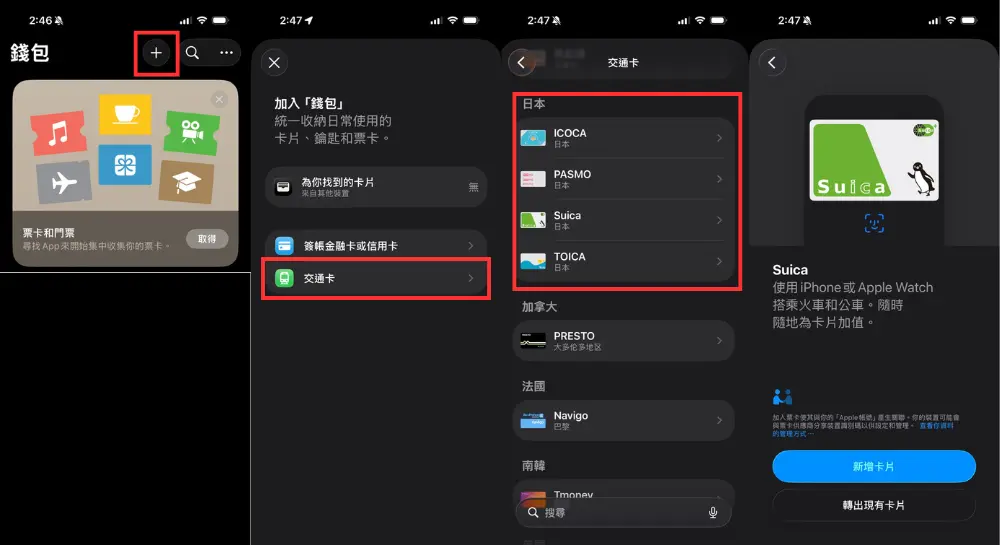
(Example shown in Traditional Chinese interface.)
In addition to purchasing a physical card at train stations, iOS users are recommended to add a digital Suica or PASMO card directly through the Apple Wallet app. This allows you to use a single smartphone for both top-ups and payments.
Open the “Wallet” app, tap the “+” icon in the top right corner, and go to the transit card section. Scroll down to the Japan transit card area and select the card you want to add. After setup, you can also recharge your transit card directly through your phone, making it extremely convenient.
Japanese transit cards are supported on iPhone 8, iPhone 8 Plus, and later models running the latest iOS version. Suica is supported on iPhone 7, iPhone 7 Plus, and later models.
❗Please note that the mobile payment function of the Suica app on Android is currently only supported on devices purchased in Japan. Overseas Android users are advised to purchase a physical card instead.
❗For the latest information, please refer to the official Apple website.
JapanTransit | A Useful App for Easily Checking Train Schedules
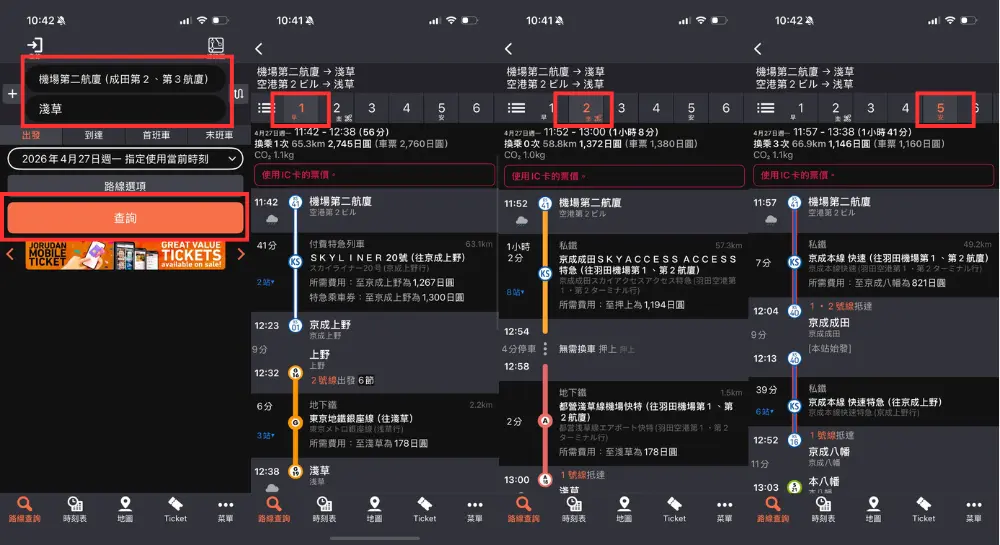
(Example shown in Traditional Chinese interface.)
After arriving in Japan, in addition to Google Maps, it is also recommended to use the “JapanTransit” app. Simply enter your departure point, destination, and preferred departure time, and the system will suggest the fastest, cheapest, or least-transfer route options.
It clearly displays train arrival times, platform numbers, and fare information, making it an essential travel assistant for independent travelers. You may also consider using the “NAVITIME” app, which provides more comprehensive route planning, transfer guidance, and real-time traffic updates. It is intuitive to use and very friendly for international visitors as well.
Tokyo Travel Must-Have - Have Fun in Tokyo Pass
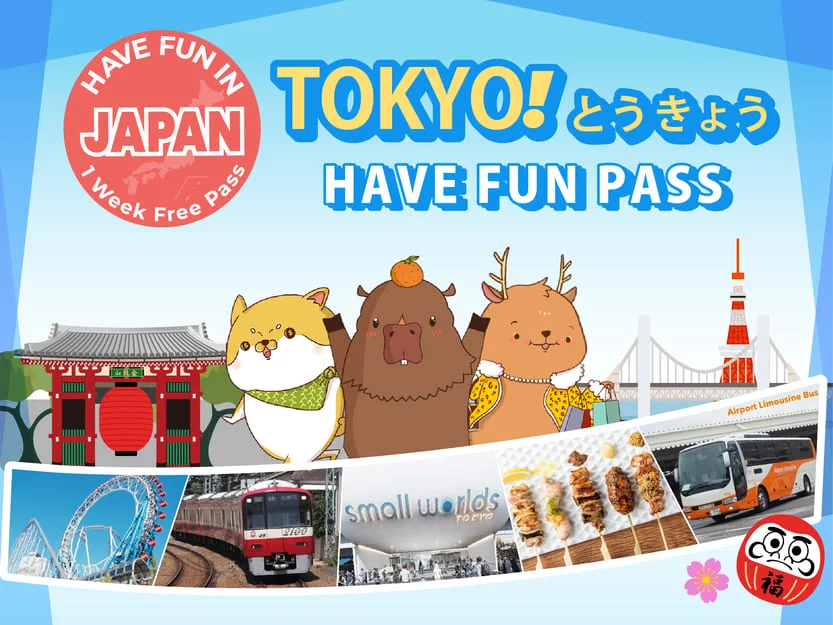
A must-have sightseeing pass for exploring Tokyo, featuring a curated selection of popular attractions and restaurants across Tokyo, Gunma, Ibaraki, Saitama, and Kanagawa. Within one week, you can choose any three facilities you like to visit. Simply present the e-ticket QR code for easy entry and experience.
Please note that the included facilities are updated periodically, so be sure to refer to the official website for the latest information.
Tokyo Airport Transportation FAQ
Q: Should I fly into Narita or Haneda for a trip to Tokyo?
If you prioritize convenience, Haneda Airport (HND) is the best choice, as it is only about 15–20 minutes from central Tokyo. If there are no direct flights to Haneda from your departure city, then Narita Airport (NRT) is a good alternative, offering the widest range of international flights and often more affordable ticket prices.
Q: How should I choose transportation from Narita Airport to central Tokyo?
For travelers who prioritize speed, the Keisei Skyliner is recommended, reaching Keisei Ueno in about 41 minutes. If you are staying around Tokyo Station, Shinagawa, Shinjuku, or Shibuya, the JR N’EX (Narita Express) is a better choice, as it eliminates the inconvenience of transferring at major stations while carrying luggage.
If budget is your main concern, you can take the Keisei Main Line or Access Express. The Airport Limousine Bus also provides direct access to major hotel areas. Although it may be affected by traffic congestion, it allows you to travel without handling your luggage.
Q: How should I choose transportation from Haneda Airport to central Tokyo?
If your destination is Shinagawa, Shinjuku, Shibuya, Asakusa, or Oshiage, the Keikyu Railway is recommended. Some services run directly onto the Toei Asakusa Line, and from Shinagawa you can also transfer to the JR Yamanote Line to reach Tokyo Station, Akihabara, and Ueno.
For travelers heading to Tokyo Station, Akihabara, or Ueno, the Tokyo Monorail is a good option. It arrives at Hamamatsucho Station, where you can transfer to the JR Yamanote Line.
If you are not in a hurry or are traveling with heavy luggage, the Airport Limousine Bus is the most convenient choice, offering direct service to major hotels and popular districts with minimal effort.
Q:What’s the difference between Limousine Bus and LCB (low-cost bus)?
The main difference between the Limousine Bus and LCB (low-cost highway bus) lies in budget and direct convenience.
The Limousine Bus has an extensive network and allows you to travel directly to major hotels in the city or Tokyo Disney Resort without the hassle of carrying luggage. It typically permits two pieces of checked baggage, making it ideal for families or travelers with heavy luggage. In contrast, LCB (low-cost highway bus) offers cheaper fares and more frequent departures, but has fewer direct stops—mainly Tokyo Station, Ginza, Ikebukuro, and Shibuya. Luggage is usually limited to one piece, making it better suited for solo travelers seeking maximum value.
Q: Can I use Suica/PASMO directly to board Skyliner or N’EX?
You cannot simply tap an IC card to board. Suica or PASMO can only be used to pay the basic fare, but since both Skyliner and N’EX are fully reserved-seat trains, you must purchase a separate limited express ticket.
It is recommended to buy tickets in advance at ticket machines in one go, or reserve online and collect physical tickets before boarding, to avoid situations where seats are unavailable.
Although transportation from Narita and Haneda airports into central Tokyo may seem complicated at first, you can easily choose the most suitable option by focusing on two key factors: your accommodation location and your budget. Be sure to check official websites for the latest information before departure.
❗The above transportation information and fares are based on April 2026 data. Please refer to official websites or station ticket counters for the latest updates.